What You Need to Know
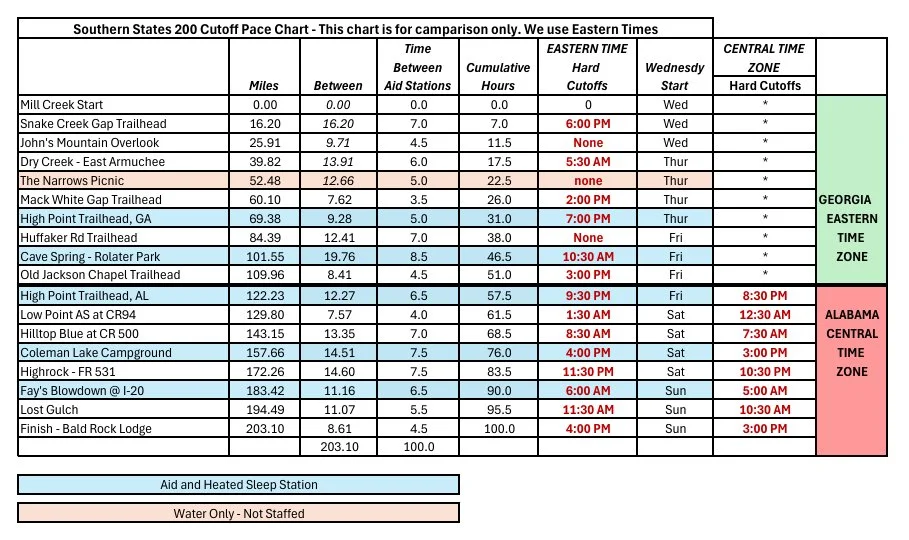
PLEASE NOTE: ALL TIMES ARE EASTERN
WHEN YOU CROSS INTO ALABAMA, 2.2 MILES PAST OLD JACKSON CHAPEL AID STATION, DO NOT CHANGE TO CENTRAL TIME. YOU MAY NEED TO SET YOUR WATCH OR PHONE TO “NOT” AUTOMATICALLY UPDATE WHEN YOU CHANGE TIME ZONES.
THE ONLY EXCEPTIONS ARE THE SHUTTLE PICKUP TIMES TO TAKE RUNNERS FROM CHEAHA STATE PARK TO THE START OF THE SS100 OR SS200. (THESE TIMES ARE NOTED AS “CENTRAL TIME”)
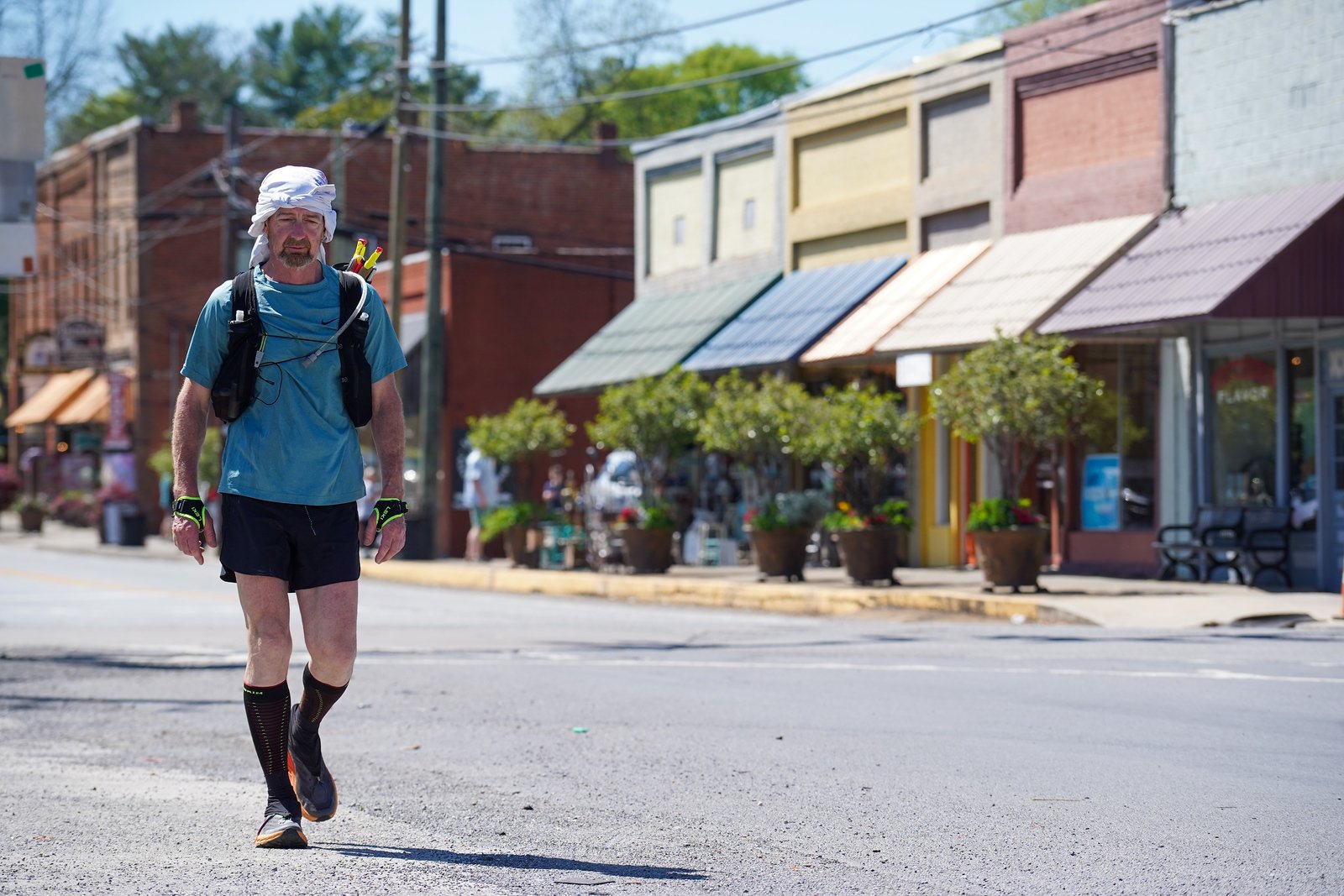
Photo from Down Town Cave Spring by Pete Schreiner
We will start with a few basic rules for the Southern States
SOUTHERN STATES 200 RACE RULES
We know this is extensive, but a 200-mile race requires strict protocols for everyone's safety. Read carefully and contact us with questions. Full details are in the runners manual—please read it!
AUTHORITY
All Race Director decisions are final
Aid Station Captains act as on-site race directors
COURSE COMPLIANCE
No Course Cutting: Stay on marked trails at all times—no bushwhacking
You're responsible for knowing and following the course
Keep your GPS navigation device charged with the downloaded course
No time adjustments for going off course
Complete the course on foot only—no assistance from vehicles, bicycles, or other runner
ROAD SECTION RULES
Run toward oncoming traffic (left side of road)
Use shoulders when available; stay at road's edge when not
Run single file at all times
Headphones: OK on trails, but remove on all road sections, road crossings, and when approaching aid stations
Reflective Gear Required at Night: Wear reflective clothing/gear OR a headlamp with rear red light. Non-compliance = immediate disqualification - Reflective vests will be available at Huffaker Aid Station
CREW RULES
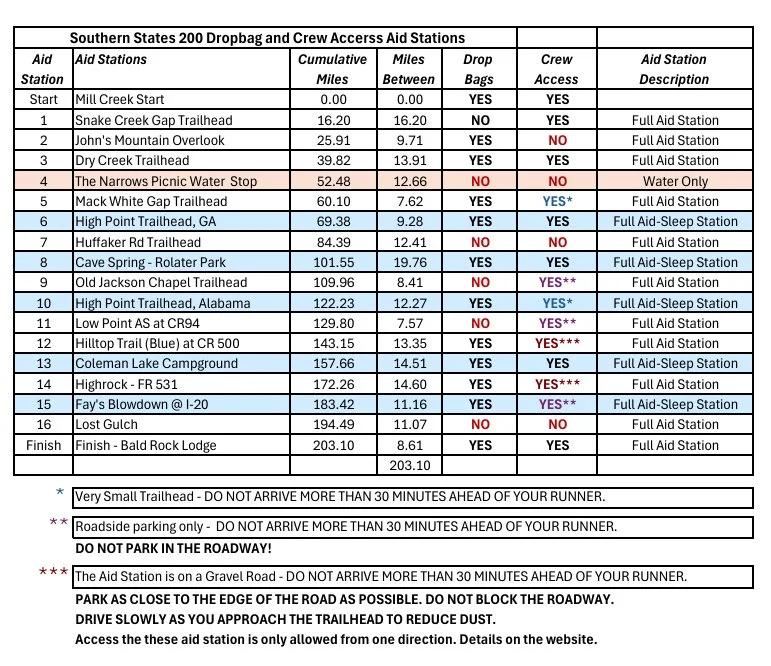
Crew may assist ONLY at crew-accessible aid stations—nowhere else on course
You're responsible for your crew's behavior
Crew must follow Aid Station Captain directions
Crew must display Southern States 200 Car Pass on dashboard with runner's name and number
Crew may NOT arrive more than 30 minutes before runner at aid stations with limited parking (watch live tracking)
Aid Station Access: Crew may enter WITH you to assist, but may NOT take food/drink from aid stations
Once you arrive and check-in at the aid station, your crew may get food from AS for you
Young children and pets are NOT ALLOWED inside aid station tents/pavilions
Crew may retrieve your drop bag before you arrive
PACERS
Allowed starting at High Point (Georgia) Aid Station, mile 71.4
Runners age 65+ may have a pacer for the entire race
Pacers must only start and stop at crew-accessible aid stations
Pacer Requirements:
Must wear the runner's pacer bib (one bib per runner—pass between multiple pacers)
Must sign Pacer Release before starting
Must check in/out with aid station personnel
Must carry all mandatory runner gear
Subject to random gear checks
Must stay with their runner (runners must slow down if pacer struggles)
May run ahead as runner approach the aid station to prepare gear
TREKKING POLES
Allowed and encouraged, especially on steep sections
When not in use: close/fold to smallest size and stow in pack
DO NOT run with fully extended unused poles
May be left at aid stations in drop bags
MEDICAL
If you require IV or oxygen (including portable oxygen canisters), your race is over—immediate disqualification
If medical personnel or Aid Station Captains deem you unable to safely continue, you must stop immediately
Decisions of medical staff or AS Captain are final—arguing changes DNF to DISQUALIFICATION
CONDUCT
No Littering: Immediate disqualification. Carry cups to the next aid station
No Stashing: Crew may NOT stash food, drink, or supplies anywhere along the course
Be Courteous: Rudeness toward volunteers, staff, other runners, or trail users (cyclists, horseback riders, hikers) will not be tolerated and may result in disqualification
Remember: volunteers have sacrificed significant time to help YOU. Save complaints for Race Directors AFTER the race
CHECK-IN REQUIREMENTS AT START
Must present government-issued photo ID to verify age and gender
No ID = No start
Must run as the gender on your legal ID
DOGS
NOT allowed to run with any runner or pacer
NOT allowed in any aid station
Must stay in crew vehicle, with crew members or at personal aid station area
Must be kept on a leash in the vicinity of the aid station
Dropping Out
Unfortunately dropping out of 200-mile races is as much a part of ultra-running as flowers are to spring. OK, maybe “storms in spring” would be a better metaphor, but whichever you prefer, it happens. If you must drop, do not just leave. You MUST go to an aid station to drop. We must know you are dropping. (And you must Return your SPOT Tracker!) Tell the Southern States 200 Aid Station Captain, or the volunteer checking runners in and out, that you are dropping. You will be marked as DNF. If you fail to do this, a few hours later, you may have some very mad search and rescue people knocking on your door. You will also be Disqualified.
Don’t give up too easily. Before you DROP, make your way to the next aid station and sleep. You can sleep any time or any place you choose, but if you make it to an aid station you will be able to eat some food and rehydrate. This will help you recover while sleeping. It’s amazing what an hour or two of sleep can do.
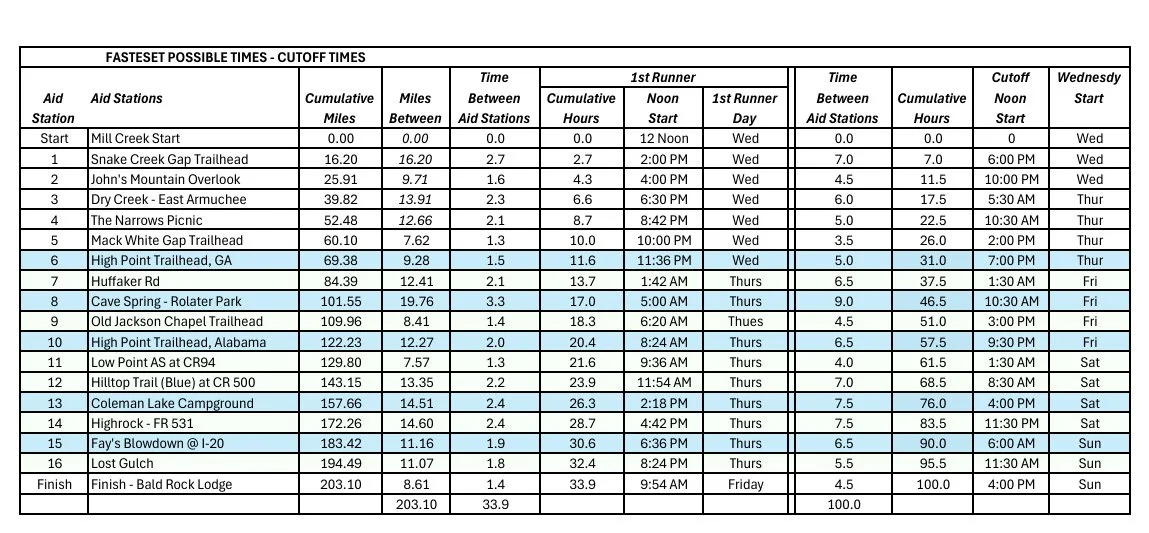
Cutoffs: Southern States 200 Cutoffs are very generous. A strong walker can finish the course, staying under cutoffs, and never run a step. We give our runners every possible chance to make the finish by the cutoff. If you are trained, stay hydrated, stay fueled and sleep, you can finish.
Weather in the Southeast
The Georgia and Alabama area can exhibit extreme weather - heat, cold, wet, dry, high winds, hail, sleet, rain severe thunderstorms, tornadoes. Mountain storms in Georgia and Alabama can be frightening. The temperature drops dramatically. You can easily become hypothermic with no aid station for miles. That’s why we require a rain jacket. Be Prepared!
A little weather example - The 2023 Lake Martin 100, Late March - Many tend to underestimate the potential for bad weather in the Southeast. Let me provide an example, The following is the weather runners encountered over a single 32 hour period. The Lake Martin 100 started Saturday at 6:30 AM, in a narrow gap between severe thunderstorms. The high Saturday approached 90 deg. Saturday night, at about 1:30 AM runners were hit by a hailstorm. At about 3:00 AM they were hit by a second hailstorm. The second was very bad. Every car at the start area was damaged. So many leaves and pine needles were stripped from the trees the ground looked like green carpet. Sunday morning, a little after sunrise, somewhere between 8 and 12 inches of rain fell over 2 hours. This is not an exaggeration. Two foot bridges washed away on tiny creeks runners would normally step over became raging rapids. At least it was warm. Storms in the Georgia mountains are another story. Some of the coldest races I have ever run were in the North Georgia Mountains in the spring and summer. Even on July 4th Weekend! Ask anyone that has run Merrill’s Mile out of Dahlonega, Georgia, more than once or twice. As stated before “BE PREPARED!”
Course & Navigation
The mountains in the Southeast may be small, but they are rugged. Single track trails require your full attention to avoid falling on your face. The course will be marked with flagging with reflective tape, yard flags with reflective tape, and arrow signs at intersections. We will thoroughly mark 100% of the course. Theoretically, you should not need any navigation aids to stay on course. Unfortunately, things happen. Storms, animals and people mess with course marking. Sometimes intentionally alter course marking. Reversing one sign can make a real mess. And then there is the effects of sleep deprivation and exhaustion after 3 or 4 days of continuous movement. Know how to use Gaia or other GPX navigation aids.
In the inaugural Southern States 200, while delivering aid stations supplies ahead of runners, I found three places where someone had altered the signs and flagging with the intent of sending runners far off course. Fortunately we were able to replace the signs and the 1/2 mile of flags that were pulled up in each case before runners arrived. Obviously, there is no guarantee we will always catch such vandalism. Know how to use that GAIA App.
This is a Cupless Event
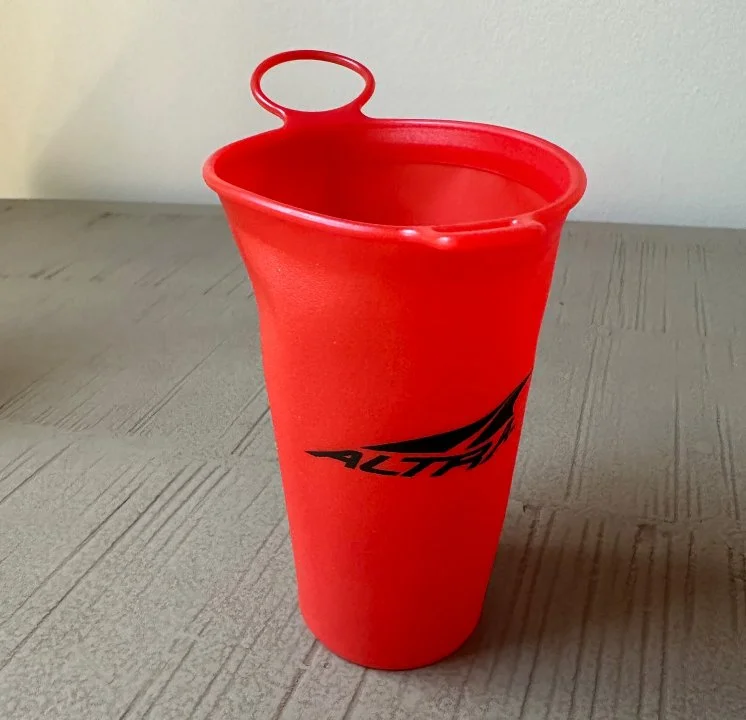
We will not provide “Cold Cups” at any aid stations for any cold drinks. That includes drinks such as water, Tailwind, cokes, pickle juice, etc. We will provide “Hot Cups” for hot soup, broth, coffee, hot chocolate, etc. There are a variety of easy to carry, lightweight cups available. The easiest to use are those soft cups with a ring on one side so they can be attached to a carabiner on your pack. I have used this Altra cup for all my races for the last two years. It’s always there when you need it. Any type of flask or water bottle will work too, or anything else you are comfortable drinking out of.

Drop Bags
Runners may have drop bags at all Drop Bag Aid Stations. (That makes perfect sense.) We will accept drop bags up to 12” X 16” X 24.” Ice chests, anything made of Styrofoam, and large tubs will not be accepted. “Dry bags” make great drop bags, maybe the best. We will accept Dry Bags up to 40L. We will try to keep drop bags out of the weather, but storms or other conditions may make that impossible. PLEASE don’t use trash bags as drop bags. Someone could confuse your DB with “Trash” and throw it out. Trash bags are also prone to tearing while being moved around. Small bins and boxes (no larger than 12” X 16” X 24.”) are OK, but be sure to tape the lid securely using duct tape. If your crew is parked in the aid station, you are welcome to use the crew car as a personal aid station. You MUST check in at all aid stations before going to your car and again when leaving the aid station. A word of caution here, due to any number of causes, your crew may not arrive at every aid station ahead of you. They may not arrive at all. It’s best to send drop bags to the aid stations. Let your crew bring that “backpack” pack loaded with the extra items you might need.
All Drop Bags must be labeled correctly. They must have the following information “CLEARLY” printed on the drop bag in an easy to find location: The runners Name, the runners BIB number, the Aid Station the drop bag is to go to.
Many Ultrarunners, especially those new to “LONG” Ultras, put everything but the “Kitchen Sink” in their drop bags. You will realize after the race that you used very little of all that stuff you spent hours, sometimes days, packing. Have an extra headlamp or flashlight in aid station bags you expect to reach at night. Have backup batteries for all of your light sources. Start with one small handheld flashlight in your pack and a set of backup batteries for your handheld light and headlamp as an emergency backup. Extra calories are critical with aid stations as much as 20 miles apart. Throw in some extra gels, cookies, tuna packets, or other of your favorite snacks. Pay close attention to the weather forecast for the race weekend. Weather can destroy your run quicker than any other factor. Have extra dry clothing in your bags. Even if there is 0% chance of rain during the race, carry an emergency poncho from the start. It’s also a good idea to have a change of shoes and socks.
Drop Bags for those Riding the Shuttle from Cheaha State Park to Dalton on Tuesday.
We will have a trailer at Bald Rock Lodge for drop bags. You may not be able to take droop bags on the shuttle. You may carry one bag on the shuttle with the things you will need Tuesday night, and what you need to start the race. (shoes, hydration pack, running cloths, supplies, etc.) If the bag is too large to go on the shuttle “comfortably,” we can carry it in the truck pulling the trailer. Wednesday morning, bring your bag with you to the shuttle when you head to the start. We will transport your bag back to Bald Rock Lodge, in Cheaha State Park, so it will be there when you arrive.
Required Gear
Each runner is required to carry the following items with them at all times during the SS200 run. When you check in at the start we will check to see that you have this stuff with you! Runners will also be subject to spot checks at any time during the run. If you do not have these items with you, you will likely be disqualified.
1) Water filter bottles such as Katadyn's BeFree. LifeStraw, or Salomon's Soft Flask XA Filter.
2) 24 oz. of water at the start of all sections. Minimum.
3) 400 extra Calories
4) Electrolytes
5) A light rain jacket or poncho.
6) Space Blanket
7) Collapsible Cup, collapsible flask or water bottle.
8) Cell Phone and a method of charging (battery packs and charging cord)
9) GPS Enabled Device with the course file loaded. Since you already have to carry a smartphone, that's the simplest option.
10) Headlamp w/ extra batteries or method of charging
11) Whistle, most running vests have one attached.
12) Warm hat or buff
13) Long sleeve top
14) gloves
15) SpotTracker (we provide)
Depending on the weather and forecast the following items might be added to the required list. Have them available, just in case.
16) Upper insulated layer (Fleece)
17) Long rainproof lower layer
18) Rain jacket with hood
We do not require you to carry an excessive amount of water on the run. The is an abundance of creeks and streams all along the course. The exception is along ridges. Keep your bottles topped off for the first 65 miles of the run. Much of this section of the Pinhoti trail follows ridgelines.
Recommended Gear
1. Gaiters
2. Trekking poles
3. Cap or sunhat
4. Sunglasses
5. Extra LED flashlight and extra batteries
In your pack:
1. A change of Socks
2. Toilet Paper in a zip lock baggie
3. Alcohol wipes
4. Extra zip locks for phone, trash, etc
5. Long Pants
6. Long sleeve layer
7. Anti-Chafe cream
8. Moleskin or other tape
9. Driver’s License & Emergency contact list
In your dropbags:
With 12 dropbag aid stations, we recommend having a variety of potentially critical items in each bag.
1. Dry long and short sleeve tops
2. Towel and washcloth
3. Alcohol wipes
4. Long Pants
5. Rain Jacket with hood
6. Extra Fleece layer
7. Sunscreen
8. Anti-chafe cream
9. Medications
10. Extra contact lenses
11. Extra Batteries and charging cord
12. Extra Toilet Paper in a baggie
13. Extra zip locks for phone & trash
On July 18th I finished the Last Annual Vol State 500K. (It’s been the “Last Annual” Vol State for 22 years.) It is possibly the most ridiculous thing I have ever done. It took me eight days, two hours, 42 minutes and 49 seconds to finish. I actually finished about 30 seconds earlier. I didn’t realize you had to grab the rail to finish. Vol State taught me four “Game Changing” lessons that can help you finishing the Southern States 200. Follow this link below to find out what I learned.